
In the world of physical therapy, one question continues to surface:
Is exercise alone enough — or does manual therapy actually change tissue capacity?
At FX Physical Therapy, this isn’t just academic. It’s foundational to how we deliver care. In a healthcare landscape increasingly dominated by exercise-only models, digital programs, and high-volume clinics, understanding what truly changes tissue capacity is critical for long-term outcomes.
If your goal is to move beyond symptom management and actually rebuild resilience, this matters.
What Is Tissue Capacity?
Tissue capacity refers to the amount of stress a muscle, tendon, ligament, or joint can tolerate before becoming painful or injured.
It includes:
- Load tolerance
- Strength and force production
- Rate of force development (how quickly you can generate force)
- Mobility and joint mechanics
- Neuromuscular coordination
- Recovery between loads
Pain and injury occur when applied load exceeds tissue capacity.
Rehabilitation, therefore, isn’t just about reducing pain.
It’s about increasing the tissue’s ability to handle stress.
The Exercise-Only Model: What It Does Well
Exercise-based rehabilitation is essential. Progressive loading is how we:
- Increase muscle strength
- Improve tendon stiffness
- Build bone density
- Enhance motor control
- Improve cardiovascular capacity
Evidence consistently shows that graded loading improves tissue resilience over time.
But here’s the limitation:
Exercise builds capacity — but it does not always restore the mechanical environment needed to build it efficiently.
That distinction is critical.
What Manual Therapy Actually Does
Manual therapy includes:
- Joint mobilization and manipulation
- Soft tissue mobilization
- Myofascial techniques
- Skilled hands-on assessment
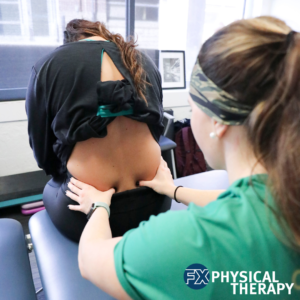
At FXPT, manual therapy is not passive fluff. It is a precision tool used to change mechanical variables that influence load tolerance.
Manual therapy can:
1. Restore Joint Mobility
Restricted joint motion alters load distribution.
If a joint isn’t moving well, surrounding tissues absorb excess stress.
Example:
Limited ankle dorsiflexion → increased knee load → patellar tendon overload.
Restoring mobility changes how force is absorbed.
2. Improve Force Transfer
Stiff or guarded tissue disrupts force transmission.
Hands-on care reduces neuromuscular guarding and improves movement efficiency.
Better force transfer = lower localized overload.
3. Reduce Protective Tone
Pain increases muscle guarding. Guarding reduces movement quality and force production.
Manual therapy can decrease pain enough to allow:
- More effective strength work
- Better motor pattern retraining
- Higher-quality exercise loading
4. Change the Starting Point
Exercise builds capacity from wherever you begin.
Manual therapy can improve:
- Range of motion
- Joint mechanics
- Symptom irritability
That means your loading program begins from a better mechanical baseline.
Manual Therapy vs Exercise Alone: The Real Answer
It’s not either/or.
It’s sequencing.
Here’s what the research and clinical experience support:
| Intervention | Primary Effect | Limitation Alone |
| Exercise | Builds strength, tendon stiffness, motor control | May be limited by joint restriction or pain |
| Manual Therapy | Improves mobility, reduces irritability, optimizes mechanics | Does not create long-term load adaptation alone |
Manual therapy prepares tissue.
Exercise builds tissue.
Together, they increase capacity more efficiently.
Why High-Volume Clinics Drift Toward Exercise-Only Models
Exercise-only care is scalable.
It requires less one-on-one time.
It fits high-throughput scheduling models.
But when manual therapy is minimized, patients often:
- Plateau
- Compensate
- Stay symptom-managed instead of performance-restored
That’s where outcomes diverge.
The FXPT Approach: Hands-On + Performance-Driven Loading
At FX Physical Therapy, manual therapy is not separate from exercise — it’s integrated into it.
Our 1-on-1 model allows us to:
- Assess joint mechanics thoroughly
- Apply skilled manual therapy to optimize movement
- Progressively load tissue with precision
- Measure strength symmetry and force output
- Build capacity beyond baseline
We don’t just reduce pain.
We increase load tolerance.
Real-World Examples
Patellar Tendon Pain
Exercise alone builds tendon stiffness.
But if ankle mobility is restricted or quad activation is impaired, load remains poorly distributed.
Manual therapy restores mobility →
Exercise builds tendon capacity →
Return-to-sport becomes safer.
Shoulder Impingement
Rotator cuff strengthening matters.
But if thoracic spine mobility is limited, shoulder mechanics remain compromised.
Manual therapy improves thoracic extension →
Strength work becomes biomechanically sound.
Low Back Pain
Core strengthening helps.
But if hip mobility is limited, lumbar segments overload repeatedly.
Manual therapy + hip mobility restoration →
Strength loading works more effectively.
What Actually Changes Tissue Capacity?
True tissue capacity improves when:
- Mechanical alignment allows efficient load transfer
- Neuromuscular inhibition is reduced
- Progressive overload is applied correctly
- Force production and symmetry are restored
Manual therapy influences the first two.
Exercise drives the latter two.
Ignoring either limits progress.
When Exercise Alone Might Be Enough
There are cases where:
- Pain levels are low
- Mobility is symmetrical
- Joint mechanics are intact
- The issue is purely deconditioning
In those scenarios, progressive loading may be sufficient.
But in persistent pain, recurrent injury, or asymmetry-driven overload — manual therapy often accelerates progress.
FAQs
Does manual therapy build strength?
No. Manual therapy does not directly increase muscle strength. It improves mobility, reduces pain, and optimizes joint mechanics — which allows more effective strength training.
Is manual therapy evidence-based?
Yes. Research supports manual therapy as an adjunct to exercise for improving short-term pain and mobility, particularly when paired with progressive loading.
Why not just stretch?
Stretching does not address joint mechanics, motor control, or tissue loading strategies. It is one tool — not a full rehabilitation solution.
How do I know if I need manual therapy?
If you experience:
- Persistent stiffness
- Recurrent pain
- Asymmetry between sides
- Pain that limits exercise progression
A comprehensive evaluation can determine whether joint mechanics are contributing to overload.
The Bottom Line
Exercise builds capacity.
Manual therapy optimizes the system that builds it.
If your goal is to move better, perform better, and reduce reinjury risk, the combination matters.
At FX Physical Therapy, our hands-on, 1-on-1 approach isn’t nostalgic — it’s strategic.
Because tissue capacity isn’t just about how hard you train.
It’s about whether your system is prepared to handle the load.